


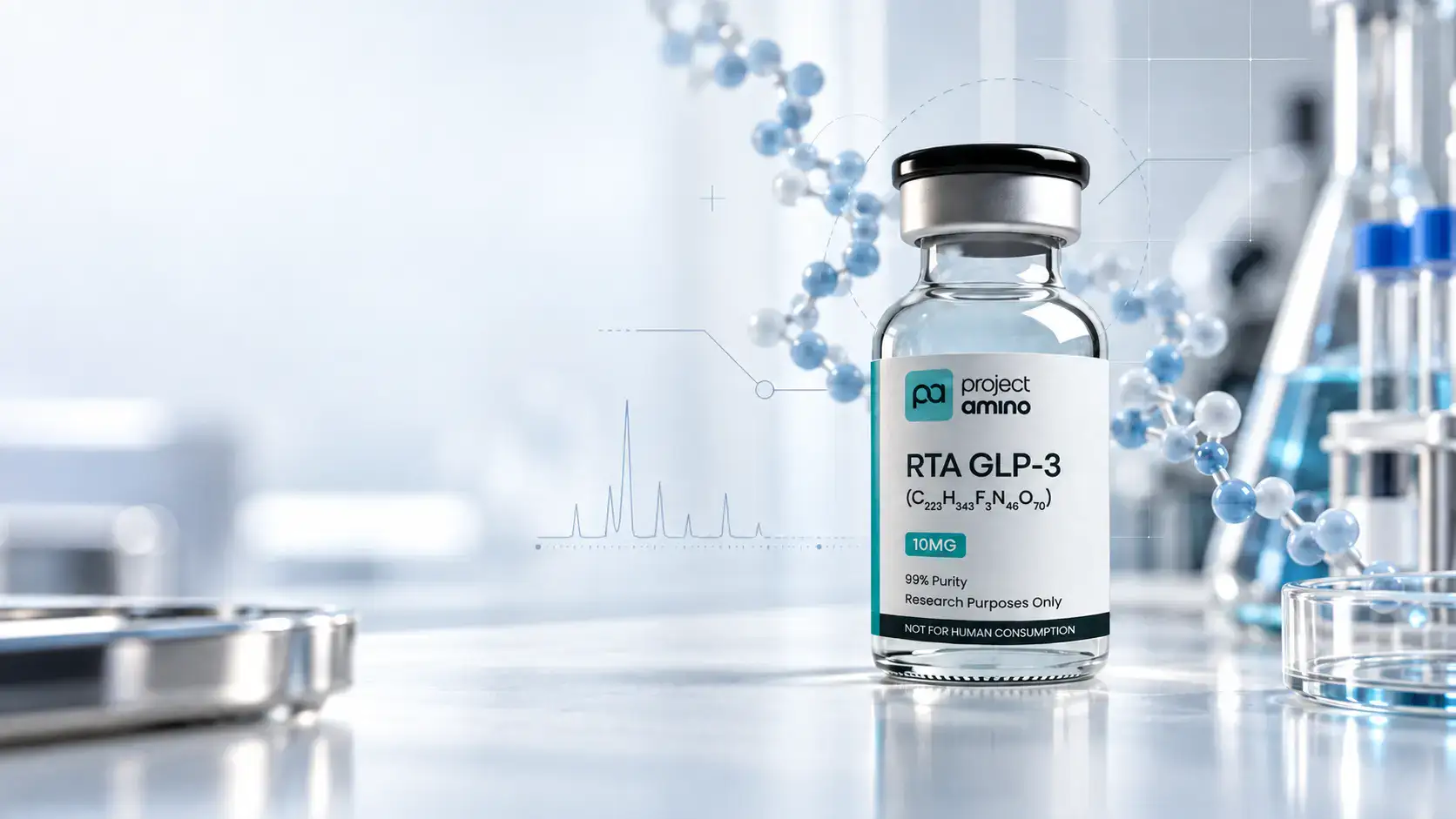
What is RTA-GLP-3R? It is an investigational synthetic peptide studied as a triple receptor agonist, supplied by Project Amino for laboratory research only. This guide covers what RTA-GLP-3R is, what published research on it looks at, and how the material is prepared, measured and stored in a lab. Each section links to a deeper reference, and to research-grade RTA-GLP-3R.
For laboratory research use only. Not for human or veterinary use. Investigational and not FDA-approved. This page summarizes published research. It gives no usage instructions.
Key takeaways
- RTA-GLP-3R is a synthetic peptide studied as a GIP, GLP-1 and glucagon receptor triple agonist.
- It is investigational and not FDA-approved.
- Lab handling follows four steps: reconstitute, work at a known concentration, store cold, track the batch.
- Published trials used gradual step-up designs to study tolerability.
- Each topic below links to its own reference. This page is the map.
RTA-GLP-3R at a Glance
- Type: synthetic peptide, GIP / GLP-1 / glucagon receptor triple agonist
- Form supplied: freeze-dried (lyophilized) powder in a sealed vial
- Measured by: volume (mL) against a known concentration
- Storage: keep sealed powder cold and dark; refrigerate reconstituted solution
- Status: research use only, investigational, not FDA-approved
- Project Amino grade: minimum 99% purity, third-party lab tested, COA per batch
What Is RTA-GLP-3R?
- A synthetic peptide that activates three receptors: GIP, GLP-1 and glucagon.
- Acting on three targets is why it is called a triple agonist. An agonist is a molecule that switches a receptor on.
- Most earlier compounds in this research area act on one or two of these receptors.
- In plain terms: one key designed to fit three locks.
What the Research Looks At
- RTA-GLP-3R is studied in metabolic research, in controlled clinical trial settings.
- A published research review describes the trial designs used.
- Trials used gradual step-up designs to study tolerability — see RTA-GLP-3R trial design explained.
- These are research settings. The compound is not an approved treatment.
Lab Handling: Overview
| Task | What it involves | Full reference |
|---|---|---|
| Reconstitution | Dissolve the powder in bacteriostatic water to a known concentration | RTA-GLP-3R reconstitution |
| Concentration reference | Concentrations for common vial sizes and water volumes | RTA-GLP-3R concentration reference |
| Concentration math | Convert between mg of peptide and mL of solution | RTA-GLP-3R concentration calculator |
| Storage | Keep solution cold and track stability against the batch | RTA-GLP-3R storage & stability |
Reconstitution
- Bacteriostatic water is added to the vial to dissolve the powder.
- Concentration = peptide in vial (mg) ÷ water added (mL). Example: 10 mg in 2 mL = 5 mg/mL.
- The water volume chosen sets every calculation after it.
- Full method: reconstitution guide.
Working with concentration
- Once mixed, the amount of peptide in any volume follows from the concentration.
- This is lab math only, not usage guidance.
- Full reference: concentration reference.
Storage and stability
- Keep sealed powder cold and away from light until mixed.
- Refrigerate reconstituted solution.
- Record batch, concentration and mixing date.
- Full detail: storage and stability guide.
Reported Research Findings
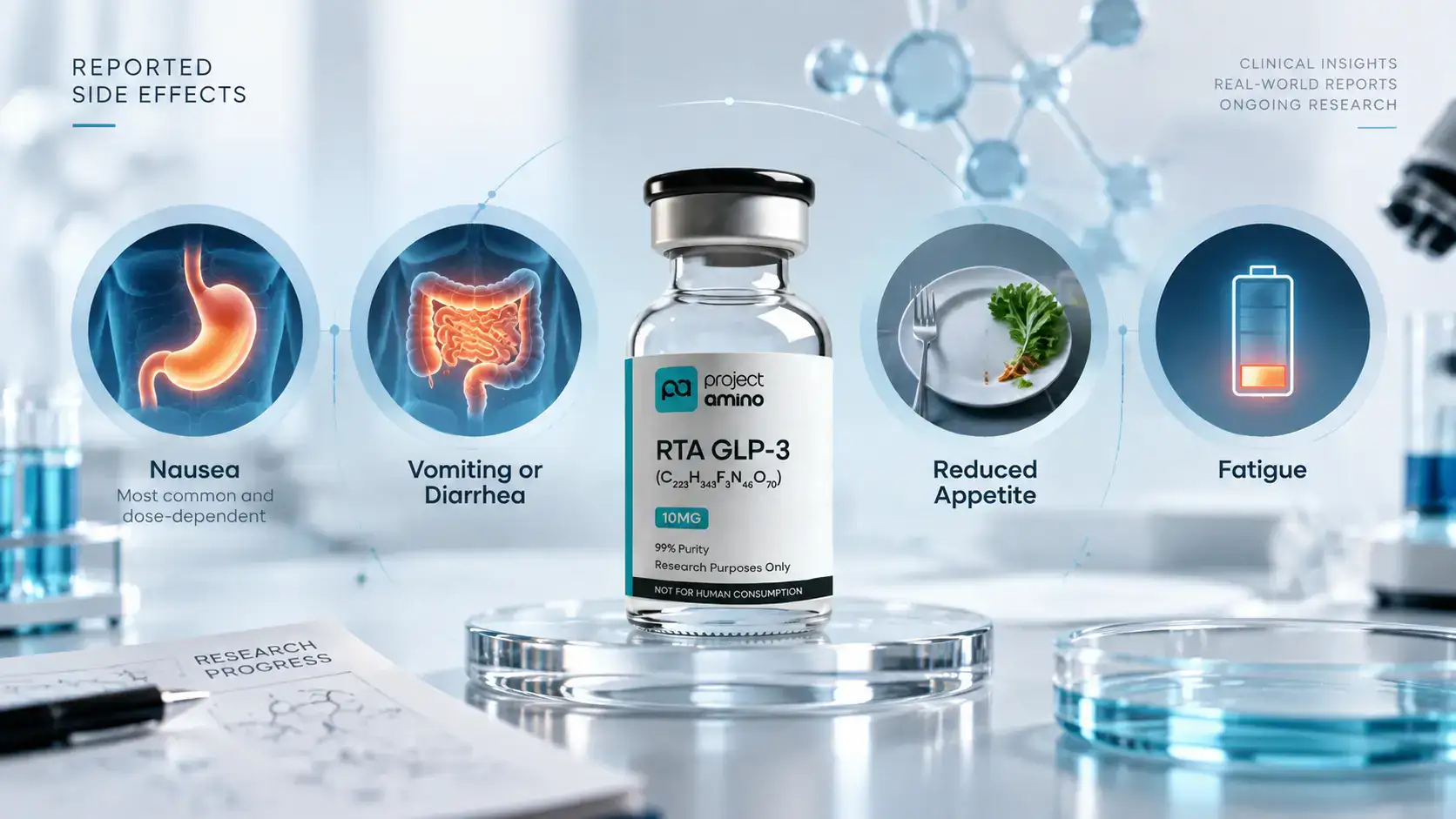
- Published trials report mostly gastrointestinal findings, such as nausea.
- Trials linked faster escalation with more of these findings.
- Long-term safety is still being studied.
- Full summary: RTA-GLP-3R reported research findings and tolerability in trials.
Is RTA-GLP-3R FDA-Approved?
No. RTA-GLP-3R is investigational and not FDA-approved. It is not a medicine or supplement. Research-grade material is sold for laboratory research only, and rules vary by state and country. Current status is tracked in is RTA-GLP-3R FDA approved.
RTA-GLP-3R Research References
- RTA-GLP-3R reconstitution: dissolving the powder to a known concentration
- RTA-GLP-3R concentration reference: vial and water combinations
- RTA-GLP-3R concentration calculator: mg-to-mL lab math
- RTA-GLP-3R trial design: how published trials were structured
- RTA-GLP-3R trial opening levels: what trials show
- RTA-GLP-3R tolerability in trials: how studies responded to findings
- RTA-GLP-3R storage & stability: keeping a mixed solution stable
- RTA-GLP-3R research findings: what the literature reports
- RTA-GLP-3R vs TRZ-GLP-2T: triple vs dual receptor action
- RTA-GLP-3R vs GLP-1 agonists: triple vs single receptor action
Research-Grade RTA-GLP-3R
Repeatable research starts with a well-characterized material. Project Amino’s research-grade RTA-GLP-3R is US-synthesized and third-party lab tested to a minimum 99% purity, with a certificate of analysis available per batch. Review testing documents on the product certificates page.
Frequently Asked Questions
What is RTA-GLP-3R?
RTA-GLP-3R is a synthetic peptide studied as a triple agonist of the GIP, GLP-1 and glucagon receptors. It is an investigational, research-use-only material studied in metabolic research.
Is RTA-GLP-3R FDA-approved?
No. RTA-GLP-3R is investigational and not FDA-approved. Research-grade material is sold for laboratory research only.
How is RTA-GLP-3R reconstituted?
Bacteriostatic water is added to the powder to make a known concentration. For example, 10 mg in 2 mL gives 5 mg/mL.
How were RTA-GLP-3R trials designed?
Published trials used gradual step-up designs under clinical supervision to study tolerability. This is a study design, not usage guidance.
Does reconstituted RTA-GLP-3R need to be refrigerated?
Yes. Reconstituted solution should be refrigerated. Sealed powder should be kept cold and away from light until mixed.
Important Regulatory Notice
RTA-GLP-3R sold by Project Amino is a research chemical for laboratory and research use only. It is investigational, not a drug, supplement or medical product, and it is not approved by the FDA. It is not intended for human or veterinary use, or for the diagnosis, treatment, cure or prevention of any disease. All statements summarize published research and are for educational purposes only. Purchasers must be 21 or older and are responsible for compliant handling.
