


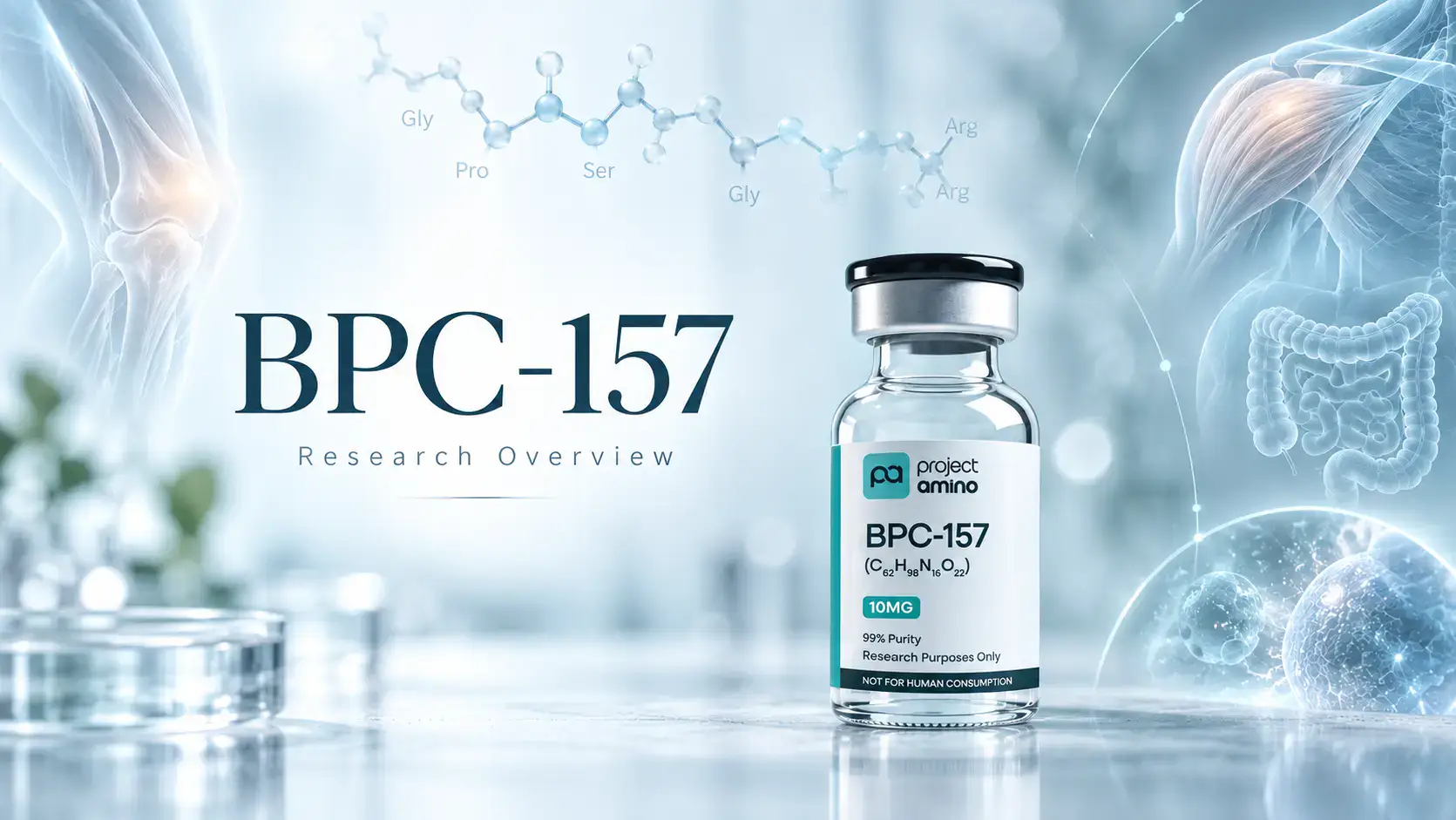
What is BPC 157? It is a synthetic peptide made of 15 amino acids. Researchers study it mainly in animal models for its reported effects on tissue repair. It is sold for laboratory research use only. This guide covers what BPC-157 is, what the published research looks at, and how the material is prepared, measured and stored in a lab setting. Each section links to a deeper reference, and to research-grade BPC-157.
Key takeaways
- BPC-157 (Body Protection Compound 157) is a stable synthetic peptide. It is sold for laboratory research only, not for human or veterinary use.
- Most published findings come from animal and lab studies. There are no completed large human trials.
- Lab handling follows the same steps in most studies: reconstitute the powder, work at a known concentration, store it cold, and track the batch.
- It is often studied alongside TB-500, another research peptide.
- BPC-157 is not FDA-approved and is prohibited in competitive sport by WADA.
BPC-157 at a Glance
- Full name: Body Protection Compound 157
- Type: synthetic peptide, 15 amino acids
- Form supplied: freeze-dried (lyophilized) powder in a sealed vial
- Measured by: volume (mL / µL) against a known concentration
- Often studied with: TB-500
- Storage: keep sealed powder cold and dark; refrigerate reconstituted solution
- Evidence level: mostly animal and lab studies
- Status: research use only, not FDA-approved, WADA-prohibited
- Project Amino grade: minimum 99% purity, third-party lab tested, COA per batch
What Is BPC 157?
BPC-157 is a synthetic peptide made of 15 amino acids. Its sequence is derived from a protein found in gastric juice. “BPC” stands for Body Protection Compound, and 157 is the fragment number. A research supplier ships it as a white freeze-dried powder in a sealed vial, which is dissolved into liquid before any measured lab work.
Two things make it a common research peptide. First, it is stable — the sequence holds up in acidic conditions in the models where it has been studied, which is unusual for a peptide. Second, it is well described in the literature, so researchers have clear reference points. Project Amino supplies BPC-157 at a minimum 99% purity, third-party lab tested, with a certificate of analysis available per batch.
What BPC 157 Is Studied For
A published research review shows BPC-157 has mostly been studied in animal models of tissue repair. Tendon, ligament, muscle and gut-lining outcomes come up most often. Reported findings describe faster healing of injured tissue in those models.
Two points belong right here. These are reported findings in animal studies, not proven human results. And BPC-157 is not an approved treatment for any condition. Because research has to be repeatable, the material must be intact, accurately measured and properly stored. The rest of this guide covers exactly that.
Lab Handling: Overview
Preparing BPC-157 for research breaks into four repeatable tasks. Each links to a full reference.
| Task | What it involves | Full reference |
|---|---|---|
| Reconstitution | Dissolve the powder in bacteriostatic water to a known concentration | BPC-157 reconstitution |
| Concentration math | Convert between mg of peptide and mL of solution | BPC-157 concentration guide |
| Routes in animal studies | How enteral and other routes compare in published animal research | BPC-157 gastric stability research |
| Storage | Keep solution cold and track stability against the batch | BPC-157 storage & stability |
Reconstitution
Reconstitution is the first step. Bacteriostatic water is added to the vial to dissolve the powder into a known concentration. Choosing the water volume deliberately is what makes every later measurement accurate and repeatable. The full method, including water volumes for 5 mg and 10 mg vials, is in the reconstitution guide.
Working with concentration
Once reconstituted, the amount of peptide in any volume depends on the concentration set during mixing. For example, 5 mg dissolved in 2 mL gives 2.5 mg per mL. That is why mixing and measuring are taught together. This is lab math only — it is not a dosing recommendation for humans or animals. The full conversion is in the concentration guide.
Storage and stability
Keep sealed powder cold and away from light until it is mixed. Store reconstituted BPC-157 in the refrigerator for a stable working solution. The storage and stability guide covers how long a mixed vial stays usable and how to track it against the batch.
BPC 157 and TB-500 in Research
BPC-157 is often studied alongside TB-500, a synthetic fragment related to thymosin beta-4. Both appear in tissue-repair research, and their reported effects in animal models are often compared side by side. When the two are combined in one vial, they share a single reconstitution and concentration, which adds a step to the math. The BPC-157 and TB-500 reference covers handling the combination.
Is BPC 157 FDA-Approved?
No. BPC-157 is not approved by the FDA for any use. It is not a medicine or a dietary supplement. In the United States it is sold as a research chemical for laboratory use only; rules vary by state and country, so buyers are responsible for knowing the rules where they are. It is also on the World Anti-Doping Agency’s prohibited list. Any product sold with health claims should be treated as mislabeled — regulators have made that point directly.
Safety Data: What Is and Isn’t Known
BPC-157 has not completed formal human clinical trials, so there is no established human safety profile. Most safety information comes from animal studies, where it has generally been reported as well tolerated at the amounts studied. Long-term safety is unknown. The BPC-157 safety literature summary covers what has been reported.
BPC-157 Research References
This is the index for the full BPC-157 reference library. Each page covers one topic.
- BPC-157 reconstitution: dissolving the powder to a known concentration
- BPC-157 concentration guide: mg-to-mL lab math
- BPC-157 gastric stability research: gastric stability and routes in animal studies
- BPC-157 storage & stability: keeping a mixed vial stable
- BPC-157 and TB-500: handling the combination
- BPC-157 study duration: how published studies structure time
- BPC-157 safety literature: what has been reported
Research-Grade BPC-157
Repeatable research starts with a well-characterized material. Project Amino’s research-grade BPC-157 is US-synthesized and third-party lab tested to a minimum 99% purity, with a certificate of analysis available per batch. Review testing documents on the product certificates page.
Frequently Asked Questions
What is BPC-157?
BPC-157 is a synthetic 15-amino-acid peptide derived from a gastric protein sequence. It has been studied mainly in animal models for reported effects on tissue repair, such as tendon, ligament and gut-lining healing. It is a research-use-only material, and these are preclinical findings, not proven human outcomes.
Is BPC-157 FDA-approved?
No. BPC-157 is not FDA-approved for any use and is not a supplement or medicine. It is sold for laboratory research only, and it is prohibited in competitive sport under WADA rules.
Does reconstituted BPC-157 need to be refrigerated?
Yes. A reconstituted BPC-157 solution should be refrigerated to stay stable. Sealed powder should be kept cold and away from light until it is mixed.
Is BPC-157 studied with TB-500?
Yes. BPC-157 and TB-500 are both studied in tissue-repair research, and their reported effects in animal models are often compared or combined.
How is BPC-157 measured in the lab?
After reconstitution, BPC-157 is measured by volume against the concentration set during mixing. For example, 5 mg in 2 mL gives 2.5 mg per mL.
What is BPC-157’s half-life?
BPC-157 is reported to have a short half-life in animal models. The storage and stability guide covers what is known.
Is BPC-157 a steroid?
No. BPC-157 is a peptide, a short chain of amino acids. It is not a steroid and does not act like one.
Important Regulatory Notice
BPC-157 sold by Project Amino is a research chemical for laboratory and research use only. It is not a drug, supplement or medical product, and it is not approved by the FDA. It is not intended for human or veterinary use, or for the diagnosis, treatment, cure or prevention of any disease. All statements describe reported research findings and are for educational purposes only. Purchasers must be 21 or older and are responsible for compliant handling.
